
Oviedo Sources That Reveal Previous Residents
Choose the first source by era. A current parcel card supplies the key that opens the title chain. For household identity, shift to directories and census schedules. The table separates verified coverage from collections whose local year run must still be confirmed.
| Source | Local time span | Where to use it | What it can establish |
|---|---|---|---|
| SCPA card and downloads | Current; certified files shown for 2021 through 2025 | Property Appraiser | Current owner, mail and situs, structure, exemption, recent sales |
| Seminole Official Records | Books from 1913; guide illustrates a 1983 web start | Clerk online and counter | Deeds, liens, plats, title and probate links |
| Orange County deeds | Before Seminole County formed in 1913 | Orange Clerk and archives | Earlier title and legal-description chain |
| Population census | 1870 through 1950 public for this area | NARA and library databases | Households, relationships, ages, occupations, and place |
| Regional directories | Miller citations confirmed for 1921, 1924, and 1926 | Library or archive item search | Listed names, occupations, spouse, and address when covered |
| Permits | Verified online start not located | Oviedo or county by jurisdiction | Building work, dates, applicant, contractor, status |
Do not turn “years it covers” into a promise that one Oviedo address appears in every volume or image. Regional directories may place the town in a county section, omit rural households, or skip publication. Clerk books can exist even when a particular image or index path requires staff help.
Begin an Oviedo House History with Today's Parcel
Search the full address in SCPA and copy the parcel ID, legal description, subdivision, lot and block, current owner, mailing and situs addresses, last qualified sale, and any deed book, page, or instrument number. Save the parcel card date. The card also may show year built, building area, land use, sketches, photos, exemptions, and improvement details.
Those facts are leads, not a roster of past residents. Mailing and situs fields can differ, and even a homestead exemption is only year-specific support for owner occupancy. A structure year helps date the building, but a rebuilt or replaced structure can sit on land with a much older title history.
Walk the Seminole County Deed Chain Backward
The title chain begins with today's owner, then reverses each conveyance. Use the Clerk's Official Records inquiry and compare every result with the parcel's legal description. A matching surname alone is too weak because one party may hold several properties.
- Find the current purchase deed using the owner, recent sale reference, instrument type, and legal description.
- Record grantor, grantee, execution and recording dates, file number, book and page, consideration, and legal wording.
- Treat the seller or grantor as the prior-owner lead, then search that person as grantee before the sale.
- Repeat the cycle, testing each instrument against the same land description and noting mortgages, satisfactions, quitclaims, probate deeds, and plats.
- When the trail reaches older records, ask Clerk Land Records about image or counter access; before 1913 move to Orange County sources.
- Grantor and grantee
- The grantor transfers an interest; the grantee receives it.
- Chain of title
- The linked sequence of recorded transfers affecting the same land.
- Legal description
- The lot, block, subdivision, or metes-and-bounds wording that identifies land despite address changes.
Why 1983 Is Not the Start of Oviedo Deeds
The Clerk's Official Record Books begin in 1913, when Seminole County was created, but the web user guide illustrates January 1, 1983 as a beginning date. These facts describe different things. One is the existence of county books; the other is a search-interface example. Do not state that Oviedo deeds begin in 1983 or assume that every older image behaves like a current online result.
Search the portal, use book and page references when known, and ask Land Records to confirm the access route for a needed older instrument. Public images are available online when not restricted. Certified electronic copies can be bought through DuProcess; paper certified copies can be requested by mail or from the Sanford land-records location.
Before 1913, an Oviedo Trail Crosses into Orange County
Seminole County was carved from Orange County in 1913. A land, probate, or court trail that reaches that boundary does not simply end. It changes custodian. Carry forward the exact legal description, party names, approximate date, and any cited book or instrument, then consult Orange County historic deeds and archival or FamilySearch catalog routes.
This is a records-geography break, not proof of a missing deed. Modern county names should not be projected backward. The same principle applies to place names: the settlement was known as the Lake Jesup community before the Oviedo post-office name appeared in 1879.
Match Oviedo Directories to Census Years
Deeds identify owners, but previous residents may include people who never held title. Directories and census schedules supply the household layer. Start near a public census year, search both names and address forms, and move through sources one issue at a time. The Oviedo directory-book guide covers the collections themselves; here they serve one address trail.
- Preserve the legal description, old street spellings, route wording, and subdivision from the parcel work.
- Search a regional directory near 1920, 1930, 1940, or 1950, recording the complete entry and abbreviation key.
- Compare 1921, 1924, or 1926 Miller evidence, where geographic coverage actually includes the subject, with the nearest census household.
- Track first and last appearances, but treat a gap as possible nonpublication, nonresponse, or omission rather than an automatic move.
- Confirm identity through spouse, occupation, employer, age, relationship, deed, obituary, probate, cemetery, or newspaper evidence.
The federal 72-year rule makes the 1950 census the latest public population schedule at present; 1960 is scheduled for release in 2032. Search township or precinct labels when Oviedo does not appear as the enumeration label.
The National Archives census guide explains access to released schedules and the federal release interval.
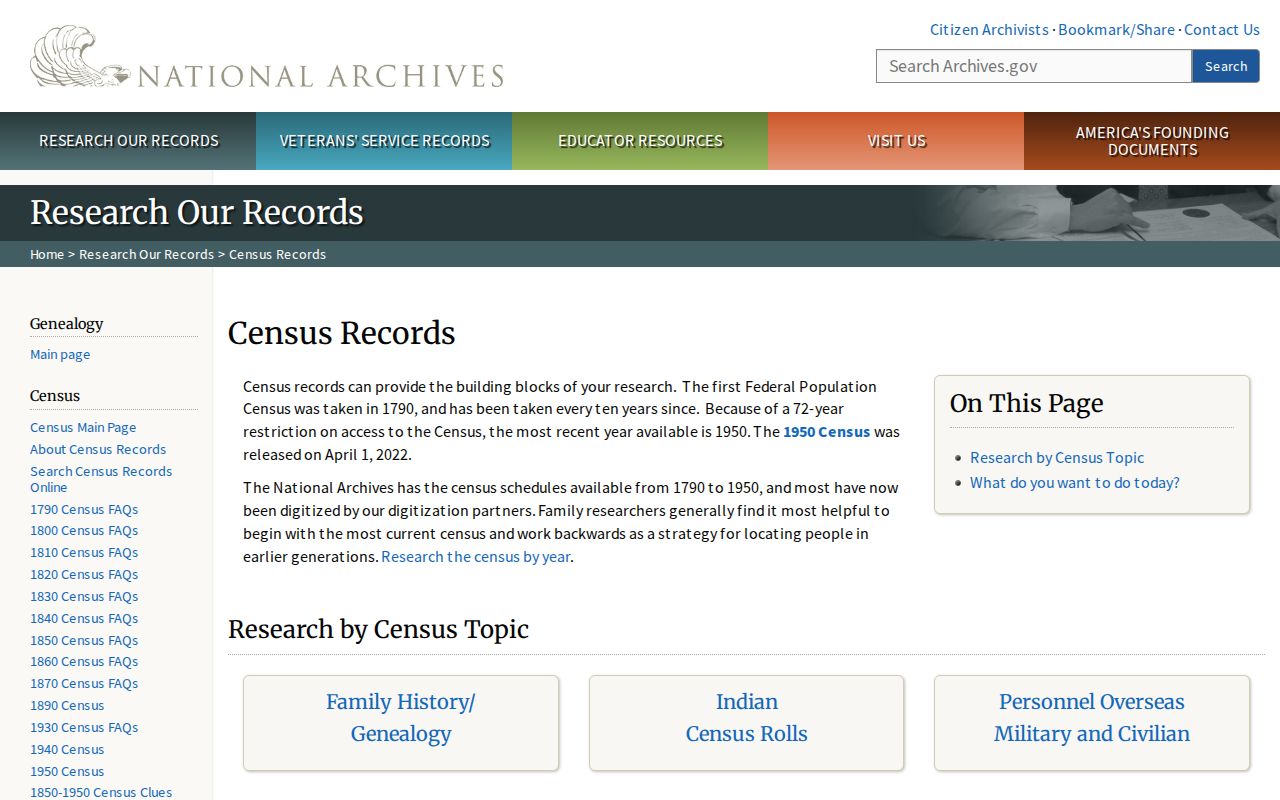
The guide clarifies why an address trail can currently reach the 1950 household schedule but not a later population census.
Search Lake Jesup to Find Oviedo Past Residents
Andrew Aulin, a Swedish immigrant and local postmaster, selected “Oviedo” for the post office in 1879. Earlier evidence may retain Lake Jesup, Lake Jessup, a rural route, or nearby Geneva, Chuluota, Sanford, or Orlando-area wording. OCR searches should test both Jesup spellings as well as surname variants.
Occupational and place clues can help. Early residents may surface in river mail, Solary's Wharf, Mitchell Dock, shipping, citrus, flower nursery, celery, vegetable, railroad, church, cemetery, or newspaper records. The 1895 freeze is a useful date around which to check land transfer, crop change, debt, or relocation evidence, but each claimed event still needs its own source.
Use Oviedo Permits to Date the Place, Not the Person
Building and code files can show work type, application date, inspection, status, and names linked to a project. A named party might be an owner, contractor, architect, business applicant, or agent. That proves an association with the work, not that the person lived there. No official public-facing historical permit-index coverage date was verified.
First use SCPA GIS to decide whether the parcel is within city limits. Ask Oviedo Building Services for city parcels and Seminole County Development Services for unincorporated postal-Oviedo sites. A specific request should state the address, record type, and date range. Florida permits oral, written, electronic, and anonymous public-record requests without a purpose statement.
When an Oviedo Sanborn Map Is Not Confirmed
The State Archives of Florida offers catalog and reference help for older address evidence.
Each map, photograph, or manuscript must be read in its own scope.
No Oviedo-specific Sanborn fire-insurance edition was verified in the Library of Congress catalog. Nearby Sanford or Orlando sheets must not be presented as if they map an Oviedo parcel. This gap is useful because it steers house history toward evidence that does exist: parcel cards, plats, deeds, permits, CRA mapping, photographs, directories, census schedules, and newspapers.
Ask Seminole County Library East Branch, Jean Rhein Central Branch, the Museum of Seminole County History, and Oviedo Historical Society about maps, vertical files, yearbooks, telephone books, and licensed Digital Sanborn access. Catalog holdings and licenses should be confirmed at the time of research.
Close an Oviedo Previous-Residents Trail
An obituary can connect relatives, former places, church ties, and burial, while probate can explain a deed succession. Neither should stand alone. Compare the obituary with death, probate, cemetery, deed, and newspaper evidence. Florida death certificates without cause are public; cause-of-death information for deaths less than 50 years old is restricted.
The Florida death-certificate page identifies the ordering channels and the distinction between public and restricted information.
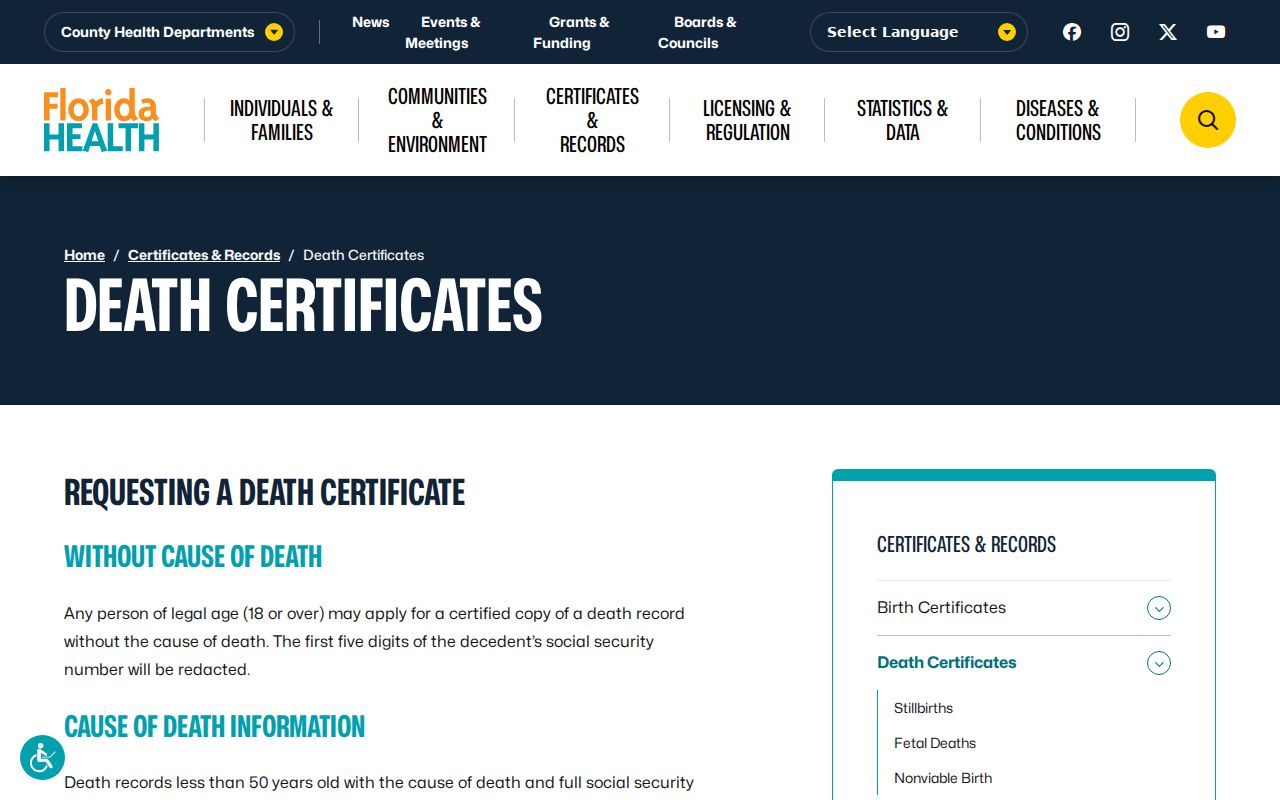
The state page helps separate a public death certification request from restricted cause-of-death details before an order is placed.
Oviedo Cemetery presents a local custody issue: records are divided between the City and Methodist Church owners, so identify the section or denomination and contact both when needed. Boston Hill Cemetery adds a distinct Black-history path tied to Antioch Missionary Baptist Church and Prince Butler Boston's 1926 dedication deed. These sources can help close an identity gap without pretending the title owner was always the occupant.
Historic Downtown Gives Oviedo Address History a Frame
The 2026 Oviedo Community Redevelopment Plan supplies current parcel-scale boundaries and a history narrative for roughly 674 acres and 698 parcels in the downtown area. It can define a manageable study area and guide a researcher toward historic parcels, plats, permits, photographs, and newspapers.
The CRA plan is geographic context, not a list of previous residents. Likewise, a present parcel map should not be projected unchanged into an earlier era. Use the plan to ask better questions, then prove owners with deeds and households with directories, census, probate, obituaries, and cemetery material.
Past Oviedo Households Require Careful Limits
A complete address history distinguishes an owner, a recorded party, a permit applicant, a directory subscriber, and a census household member. Dates matter because each source freezes a different moment. Protected addresses, sealed or juvenile material, restricted vital information, motor-vehicle data, and later census schedules remain unavailable or limited.
Lawful house history. Research previous residents for genealogy, property history, or an estate matter, and never use old or current clues to track or harass someone.
End with a source log that states what each item proves, what it merely suggests, and what remains unresolved. That habit keeps a compelling story from outrunning the evidence and gives the next researcher a clear path back to the custodian.