
Start an Oviedo Residents Directory Search
A useful search begins with the clue already in hand. A street address points first to the Seminole County Property Appraiser. A personal name may fit the property roll, Official Records index, court search, professional-license files, or voter verification tool. A past date belongs in city directories, census schedules, deeds, probate files, and cemetery records. No one source is a complete Oviedo residents directory because owners, registered voters, license holders, parties to recorded documents, and renters are different groups.
Build a small evidence chain. Match a person to a parcel or document, check the date, and then compare another official index. A mailing address can differ from the property address, and a name in a deed does not prove current residence. The strongest result is a consistent match across independent records.
- Search the county property roll by owner, street, address, parcel, facility, or subdivision.
- Use the Seminole voter tool when the person's first name, last name, and birth date are known.
- Check the Clerk's grantor and grantee index for deeds, mortgages, liens, and related instruments.
- Move to historical directories and census schedules when the question concerns an earlier household.
- Ask the correct custodian for a record that is not published online.
Search Fields Inside the Oviedo Property Roll
The Seminole County Property Appraiser offers the broadest address-based starting point. Its quick search accepts several kinds of clues, which helps when spelling or house numbers are uncertain. Results can connect a situs address with an owner, parcel identifier, legal description, assessed values, sales history, and building facts. The mailing address may belong to an owner who lives elsewhere, so it must not be treated as a household list.
| Search input | Best use in Oviedo | What to verify next |
|---|---|---|
| Owner name | Find parcels tied to a known person or entity | Compare the deed index |
| Street name or address | Locate one property or browse a named road | Confirm situs and city limits |
| Parcel number | Return to the exact tax parcel | Match legal description |
| Facility or subdivision | Narrow a campus, complex, or recorded development | Inspect map and plat |
The captured property-search screen shows those entry points together. Once a parcel is found, the map and Clerk records provide the context that a roll alone cannot supply.
View the official SCPA search interface.

The owner, parcel, street, address, facility, and subdivision choices make the portal useful even when the starting clue is incomplete.
Offices Behind Oviedo Resident Records
Oviedo has no separate recorder of deeds or city assessor. Most present-day resident evidence runs through countywide offices, while City Hall keeps records created by city government. That division matters. A deed or parcel question goes to Seminole County; an Oviedo permit, code matter, council action, contract, or city public-record request goes to the City Clerk. Before filing a request, name the record, date range, address, or case number as precisely as possible.
Oviedo Deeds Begin With a 1913 County Line
Seminole County was created from Orange County in 1913, and the Clerk's Official Record Books begin that year. That boundary in the archive changes how an older Oviedo search works. A twentieth-century deed chain can usually proceed through Seminole County books and the modern online index. An earlier conveyance may belong in Orange County's older series or archival microfilm instead.
This is more than a history footnote. Researchers sometimes assume a missing pre-1913 name means no record exists. The likely problem is jurisdiction, not absence. Record the legal description from the earliest Seminole instrument, then use that land description when moving backward because street names and postal addresses are less stable than the parcel's formal identity.
Record terms. A roll is a compiled official list. An index points to a document. A parcel is a mapped tax unit. A criss-cross directory organizes entries by address rather than surname.
Current Oviedo Directory Sources Compared
Each current source covers only the people connected to its legal purpose. The Oviedo residents directory therefore works best as a comparison table, not as a promise that every household appears. Property records emphasize ownership. Voter records concern registration. Recorded documents identify parties to instruments. City directories list departments and staff, not the general public.
| Official source | People represented | Custodian | Public route |
|---|---|---|---|
| Property roll | Owners and mailing recipients | Seminole Property Appraiser | Free web search |
| Voter information | Registered voters | Supervisor of Elections | Identity-based verification or extract request |
| Official Records | Parties to deeds, mortgages, liens, plats, and judgments | Seminole Clerk | Free index and available images |
| City staff directory | Oviedo departments and personnel | City of Oviedo | Free online directory |
| Professional licenses | State-regulated practitioners and businesses | DBPR or Department of Health | Free public lookup |
A person absent from one row may still appear in another. A renter may not be named on the parcel card, while an out-of-town owner may appear prominently.
What Florida Opens in an Oviedo Voter Record
Florida treats voter registration and voting history as public records, including name, address, date of birth, party, phone, and email. The law withholds Social Security numbers, driver-license or state-ID numbers, the application source, and copies of signatures. Protected-address rules can also limit disclosure for eligible people. Public does not mean unrestricted in purpose or free from safety duties.
The Seminole individual voter lookup is not an open browse-by-street directory. It asks for first name, last name, and date of birth to verify a particular record. Broader Florida voter extracts follow a written request process and are distributed monthly on disk rather than by email or download. Those mechanics make the voter file a confirmation source, not the first stop for casual browsing.
Use records lawfully. Public information may support family, civic, estate, and personal research. Never use it to stalk, intimidate, harass, or harm someone.
An Oviedo Postal Address May Fall Outside Oviedo
A postal city name is a delivery convention, not a municipal boundary. The Oviedo mailing area extends into unincorporated Seminole County and toward the UCF and east Orange County fringe. A record seeker who assumes every “Oviedo” address sits inside the 16-square-mile city can ask the wrong government for permits, code files, or police material.
Confirm jurisdiction with the parcel record and a GIS city-limit layer before choosing the custodian. City-created records belong with Oviedo only when the property or event falls within city authority. County systems still govern deeds, property assessment, and many other records throughout Seminole County. This geography check saves time and explains why two nearby addresses can follow different permit and code-enforcement trails.
Oviedo City Requests When the Index Stops
The City Clerk accepts sufficiently specific oral, written, or electronic public-record requests. A requester does not have to explain the purpose or use a special form, and anonymous requests are accepted. Useful narrowing details include a date span, keyword, police case number, fire incident number, or street address. The city's holdings include fire, permitting, personnel, police, and other municipal records, but vital, marriage, and divorce certificates belong elsewhere.
The city says requesters should expect an acknowledgment, request number, and any fee notice within two business days. Electronic delivery of nonexempt, nonextensive material is normally free. Paper copies through 11 by 17 inches cost $0.15 per one-sided page; larger duplication costs the actual amount, and extensive research can add labor charges. Delivery can be by email, fax, mail, or pickup.
Oviedo Vital Records Have Different Doors
Birth, death, marriage, and divorce records do not share one access rule. Florida birth records less than 125 years old are confidential and limited to eligible applicants. Death certificates without cause of death are public, while cause-of-death information for deaths less than 50 years old is restricted. Marriage and divorce certifications are public, with the state series beginning June 6, 1927. Earlier records must be sought at county level.
The Florida Bureau of Vital Statistics gateway lays out the certificate routes and eligibility rules. The captured gateway helps distinguish a certificate order from a name index or directory search.
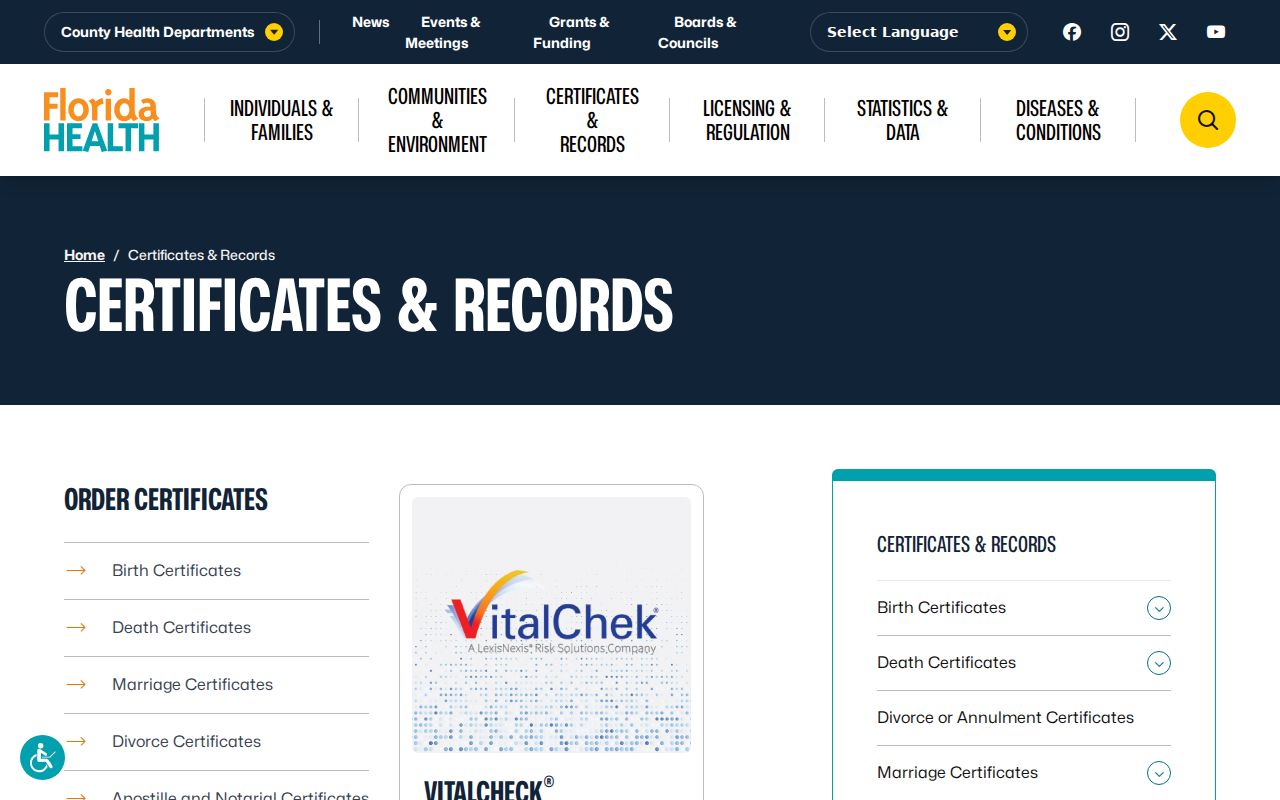
The separate certificate paths show why a resident search must match the request to the record type and the applicant's eligibility.
Official Oviedo Rolls Versus Commercial Results
Official portals are narrower but easier to evaluate. They identify the custodian, describe the record's purpose, and often show a document date, parcel, case, license, or filing number. Commercial people-finding products may combine many sources without revealing when a field changed or which office created it. That difference matters when two people share a name or an address is old.
Official record
Best for a dated, source-specific fact that can be checked with the custodian. Coverage is limited to the agency's function.
Compiled result
May offer leads across sources, but can merge names, repeat stale addresses, or hide the underlying date and document.
Use the Oviedo residents directory as a route to primary sources. Preserve the record number and date, then verify any important conclusion with the office that holds the original.
Historical Oviedo Directory Shelves and Archives
Older Oviedo residents appear through a patchwork of city directories, telephone books, census schedules, newspapers, cemetery files, photographs, maps, and manuscripts. The State Library of Florida maintains city-directory holdings and reference help, while Florida Memory supplies digitized historical collections. The East Branch of the Seminole County Library is the local branch, and the Museum of Seminole County History adds county context. The Oviedo Historical Society also points researchers toward local reference material.
A city directory can place a householder at an address, sometimes with occupation or spouse, while a later criss-cross volume can be searched from the address side. Census schedules add household relationships at released intervals. Cemetery and obituary evidence can bridge gaps when a printed directory run is incomplete. The full shelf and reading method belong in the Oviedo city directory guide.
Oviedo Permits Reveal Activity, Not a Household
Building permits and code cases can connect a name, contractor, applicant, or owner with work at an address. They are useful for a property timeline, especially when paired with parcel sales and deeds. They are not a resident roll. The person named on an application may be a contractor, agent, former owner, or business contact rather than someone who occupied the site.
Start by confirming whether the parcel lies inside Oviedo. Then search the city's permit channel or request a file using the address, approximate date, and project type. Compare any name with the property record and recorded instruments. That order prevents a common mistake: turning evidence of work performed at a property into an unsupported claim about who lived there.
Oviedo Name Matches Need Two Anchors
A common name can appear in property, court, license, business, and recorded-document systems without every result belonging to one person. Use two stable anchors before treating a match as useful: an address plus a date, a parcel plus a deed reference, a license number plus profession, or a court case number plus filing details. Middle initials help, but they are not enough by themselves.
The same caution applies to companies. Sunbiz can connect a business entity with a registered agent or filing address, while DBPR and the Department of Health can confirm regulated licenses. Those sources show a formal relationship, not necessarily residence. A careful Oviedo residents directory search states exactly what the record proves and leaves broader conclusions open until another source agrees.